
The reason for vaccination not doing enough to stave off infection is partly that the rates of the fully vaccinated population are still below 20 per cent in most districts.

It emerges that Vi has probably offered good data quality despite being short on spectrum and infrastructure due to its stretched finances. Did the two companies that merged face the heat due to price wars? Probably. Did the government's tough stance in demanding its "due" share of telecom revenues hurt the company? Certainly!
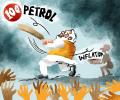
An average Indian spends no more than Rs 1.3 lakh per year, according to official statistics. This is close to what an average Indian earns annually. At this level of per capita income today, one litre of petrol costs one-third of an average Indian's daily income (Delhi prices), making it highly unaffordable. People in most other Asian and emerging countries find it more affordable.

India has placed orders for 786 million doses till date -- less than the probable need of 950 million doses, reports Abhishek Waghmare.

About 150 years ago, in British India, big farmers in the western region of Maharashtra agitated over unfair lending practices and demanded a more fair and inclusive financing structure. People say this is where the seeds of the cooperative movement, now omnipresent in the country, were sown. Today, more than 800,000 cooperative societies thrive in India, with 300 million members, a number close to the population of the United States. Despite a reach this deep--grass roots as they call it--cooperatives do not occupy a lion's share in the Indian economy.

Whenever the Census operation resumes, it will capture the impact of Covid-19 to a large extent, including the extra-lethal second wave, reports Abhishek Waghmare.

To give an impetus to 'Digital India', Prime Minister Narendra Modi had in 2015 announced the smart city mission. The primary objective of the government was to develop 100 smart cities within five years. While the first crop of smart cities was to have been ready by later this year, others were to be developed by 2022-23. But India seems to be falling behind on the timeline.

The average rate of COVID-19 vaccination in the country has been 10.8 million per week. At that rate, it will take India till December 2024 to complete two billion doses.

Districts with a higher literacy level tend to perform better in vaccination than districts with low levels of school-going population, finds Ishaan Gera.

This will cost the government Rs 3.1 trillion, about 10 per cent of its annual expenditure, and higher than any other spending item in its Budget.

As India begins vaccinating the younger population, the most vulnerable remain largely unvaccinated.
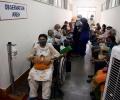
UP Rs 50 billion, followed by Maharashtra, Bihar, and West Bengal which may need close to Rs 25 billion for the massive task.
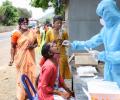
Three of the four major states delayed testing despite worsening indicators. Only Tamil Nadu quickened the pace after the first signs of deterioration.

As the second wave sweeps through the country, restrictions on movement and public activity are not as strict, even though the caseload and death rate is worse than before, reports Abhishek Waghmare.

Despite being a neighbour, Pakistan has never accounted for more than 2 per cent of India's total exports, and its share in India's total imports is less than 1 per cent. On the other hand, bilateral trade between India and Bangladesh has increased five times.
It has taken 51 days to reach a daily caseload of 84,000 from 11,000, as against 85 days taken in the first wave, report Abhishek Waghmare and Sohini Das.

Given India's reliance on coal, electric vehicles could at best be 10% more efficient than petrol in terms of CO2 savings.

To achieve herd immunity, rapid vaccination is the only hope.

While the Constitution makes everyone in India eligible to work anywhere in the country, states have used legal loopholes to frame laws.
While consumers feel that petrol pinches directly, diesel hurts indirectly, as it is an input in almost all the goods and services we use.
 © 2025 Rediff.com - Investor Information - Advertise with us - Disclaimer - Privacy Policy - Sitemap - Feedback - About us - Terms of use - Grievances